All the Best: Folk Music of St. Johns, Newfoundland

The early 2010’s were an amazing time to get really into record collecting, at the time not a lot of people (at least in my area) were doing it, so I was always able to find an abundance of albums and artists I’ve never heard of. Sometimes it was just it looked neat, other times it was “well, this might have something good on it” – I took a deep dive into buying lots of Canadiana – being a Canadian, it’s what we do. The cool thing was finding compilation albums, because you never know what you’ll walk away with, especially when you get albums from a specific geographic region – like this Newfoundland record.
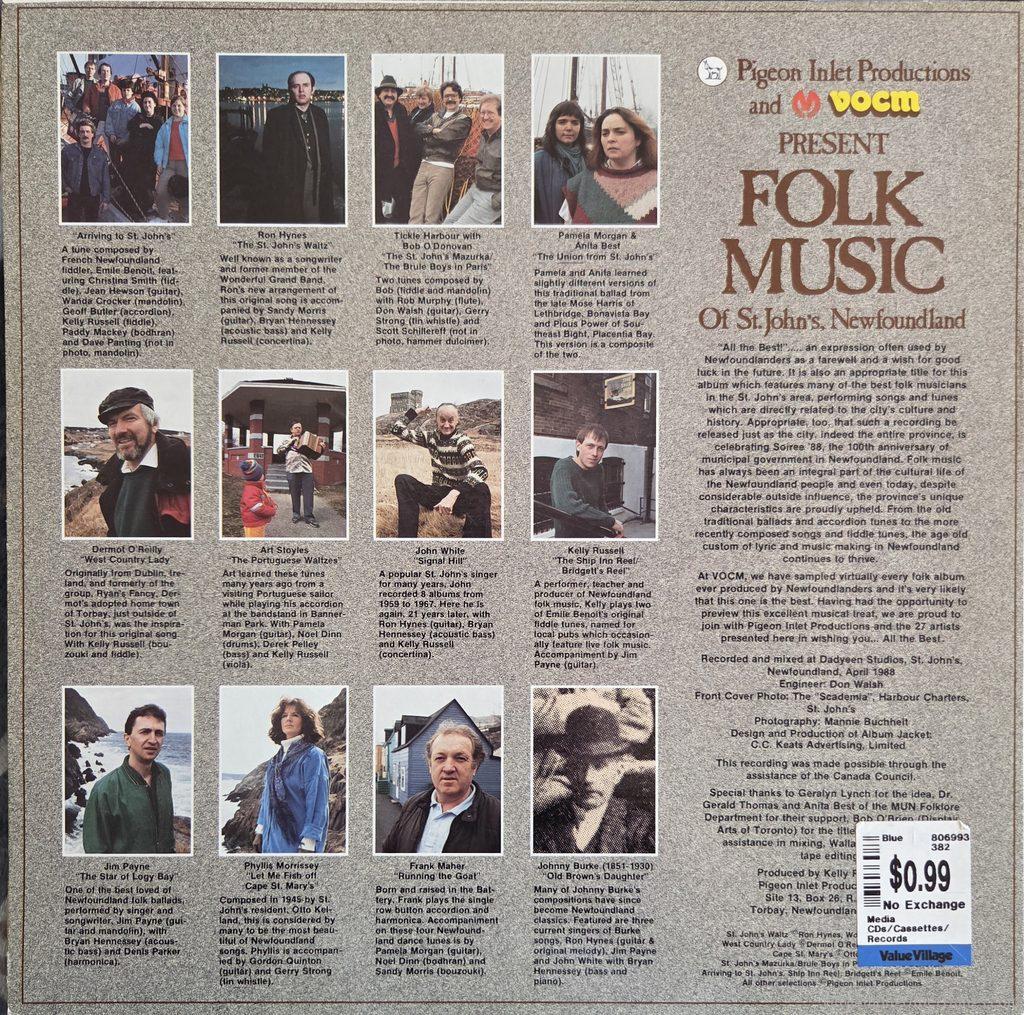
Now, I’ve always liked waltzes and jigs – so a compilation album like this is right up my alley, we open the album with a track called “Arriving in St. Johns” which is performed by Christina Smith (fiddle), Jean Hewson (guitar), Wanda Crocker (mandolin), Geoff Butler (accordion), Kelly Russell (fiddle), Paddy Mackey (bodhran) and Dave Panting (mandolin) – it’s a nice little waltz, composed by French Newfoundland fiddler, Emile Benoit. I am quite partial to the use of the accordion, and the fiddle. It makes for a really nice listen. We continue with Ron Hynes singing the song “The St. John’s Waltz” – it’s a slower song, but it’s performed really nicely, Ron has a very nice voice. The song itself is well written, the accompaniment of Sandy Morris on guitar, Bryan Hennessy on acoustic bass and Kelly Russell playing the concertina makes for an excellent sound. There does seem to be some harmonica on it as well, which I really like. Tickle Harbour with Bob O’Donovan come next with their medley of “The St. John’s Mazurka / The Brule Boys in Paris” – and this is another instrumental like the first track, featuring Bob O’Donovan on fiddle and mandolin, Rob Murphy on the flute, Don Walsh on guitar, Gerry Strong playing the tin whistle and Scott Schillereff playing the hammer dulcimer. The use of the flute and the tin whistle is a very great combo in my opinion and reminds me much of my Irish roots. “The Union from St. John’s” by Pamela Morgan and Anita Best perform this traditional ballad written by Mose Harris. There is no backing musicians on this, just the two ladies singing their ballad with their almost Angelic voices. I don’t think a lot of people realize how musically diverse that Canada is from each province to each territory, I’ve heard so much beautiful music while diving in our musical landscape. Dermot O’Reilly comes with “West Country Lady” and he delivers a wonderful song. Dermot originally came to Newfoundland from Ireland, and you can really hear it in his singing. He’s accompanied by Kelly Russell on bouzouki and fiddle, while he plays the guitar. It’s a nice and peaceful song. Art Stoyles follows along with “The Portuguese Waltzes” and Art is an accordion player, so you know that this is magical. He’s accompanied by Pamela Morgan on guitar, Noel Dinn on drums, Derek Pelley on bass and Kelly Russell makes another appearance playing the viola this time. Kelly sure seems to be a very talented multi-instrumentalist. I actually quite enjoy this one, it has a very nice beat and rhythm to it. I think there is no better way to close out the A-Side then with this song.
The B-Side opens with John White performing “Signal Hill” – the back cover features a picture of John White at Signal Hill in Newfoundland as well. John White was a very well known and popular Newfoundland singer, recording 8 albums between 1957 and 1967. He delivers a wonderful song here, accompanied by Ron Hynes on guitar, Bryan Hennessy on acoustic bass and, of course, Kelly Russell on concertina. Fantastic song. Finally, we get to Kelly Russell, performing a medley of Emile Benoit’s original fiddle tunes, “The Ships Inn Reel / Bridgett’s Reel” – he plays the fiddle beautifully, and the accompaniment of Jim Payne on the guitar just hits all the right accents. That one little note at the end on the guitar is like the icing on the cake. Jim Payne then follows with “The Star of Logy Bay” and not only does Jim sing the song, he also plays the guitar and mandolin on this one, he’s accompanied by Bryan Hennessey on acoustic bass and Denis Parker on harmonica. The song is actually a beautiful love ballad. I’m actually half disappointed that it took me so long to actually get this album on the turntable, but I’m also kind of happy because I feel that I had to reach a certain point in my maturity to truly enjoy the beauty of Newfoundland music. Phyllis Morrissey comes next with “Let Me Fish Off Cape St. Mary’s” – it’s a beautiful song, and it feels like these women in Newfoundland all sing with such Angelic voices. Phyllis is accompanied by Gordon Quinton on guitar and Gerry Strong on the tin whistle, which the two of them have a little musical interlude, before Phyllis comes back in with her beautiful vocals. Frank Maher comes next on his accordion, playing the song “Running the Goat” it’s fast, it’s upbeat and he also plays the harmonica on this one. The song is a popular dance tune in Newfoundland. He’s accompanied by Pamela Morgan on guitar, Noel Dinn on the bodhran and Sandy Morris playing the bouzouki. If ever you’re sad, you should just listen to the instrumentals on this album. They will uplift you. The album closes with John White and Jim Payne singing Johnny Burke’s “Old Brown’s Daughter” and these two men have wonderful harmony vocals when they sing together. Ron Hynes also plays the guitar, while Bryan Hennessey plays the bass and piano. It’s a short song, but a beautiful song to close the album out with.
You can listen to the whole album here.
Catalog Number:
PIP-7322
Credits:
Recorded and Mixed at Dadyeen Studios, St. John’s, Newfoundland, April 1988
Engineer – Don Walsh
Front Cover Photo – The Scademia, Harbour Charters, St. John’s
Photography – Mannie Buchheit
Design and Production of Album Jacket – C.C. Keats Advertising, Limited
Producer – Kelly Russell
Released:
1988
Find it on Discogs


