Alabama – “Mountain Music”
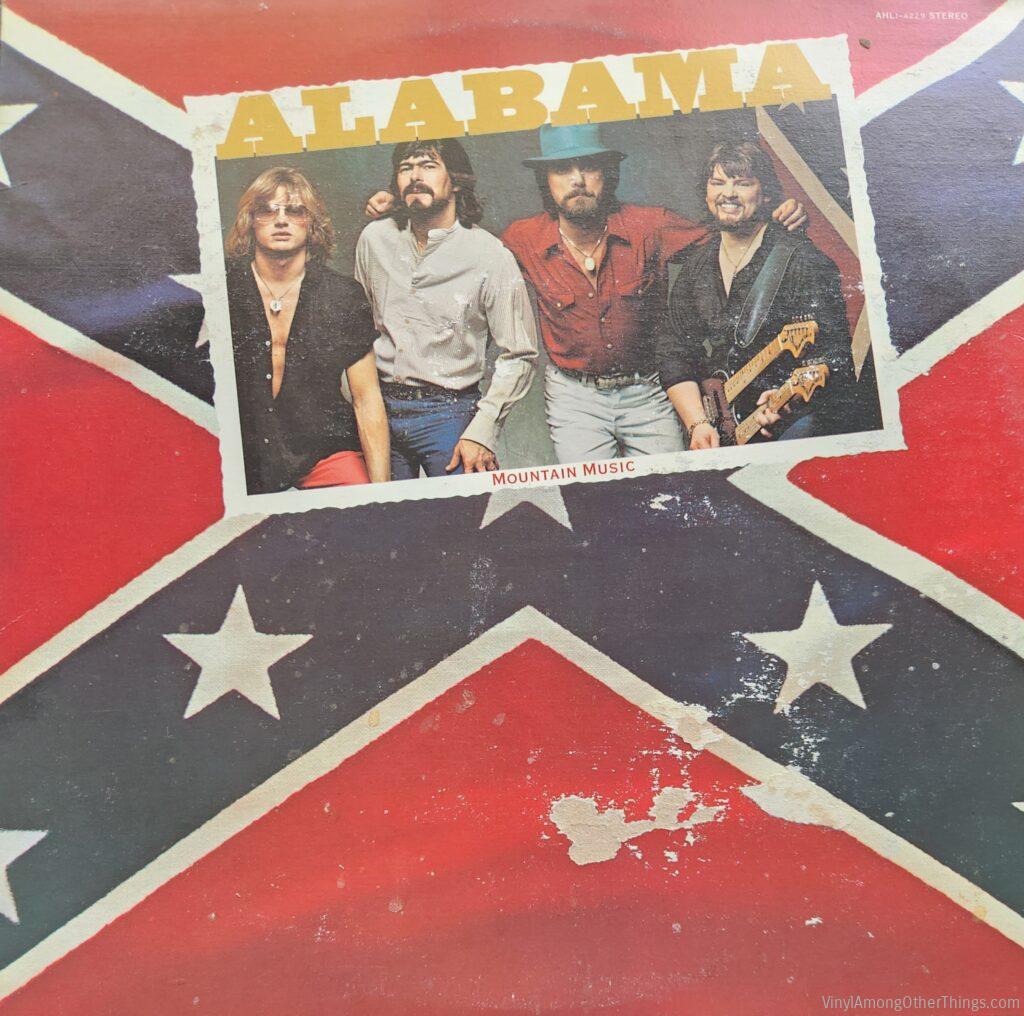
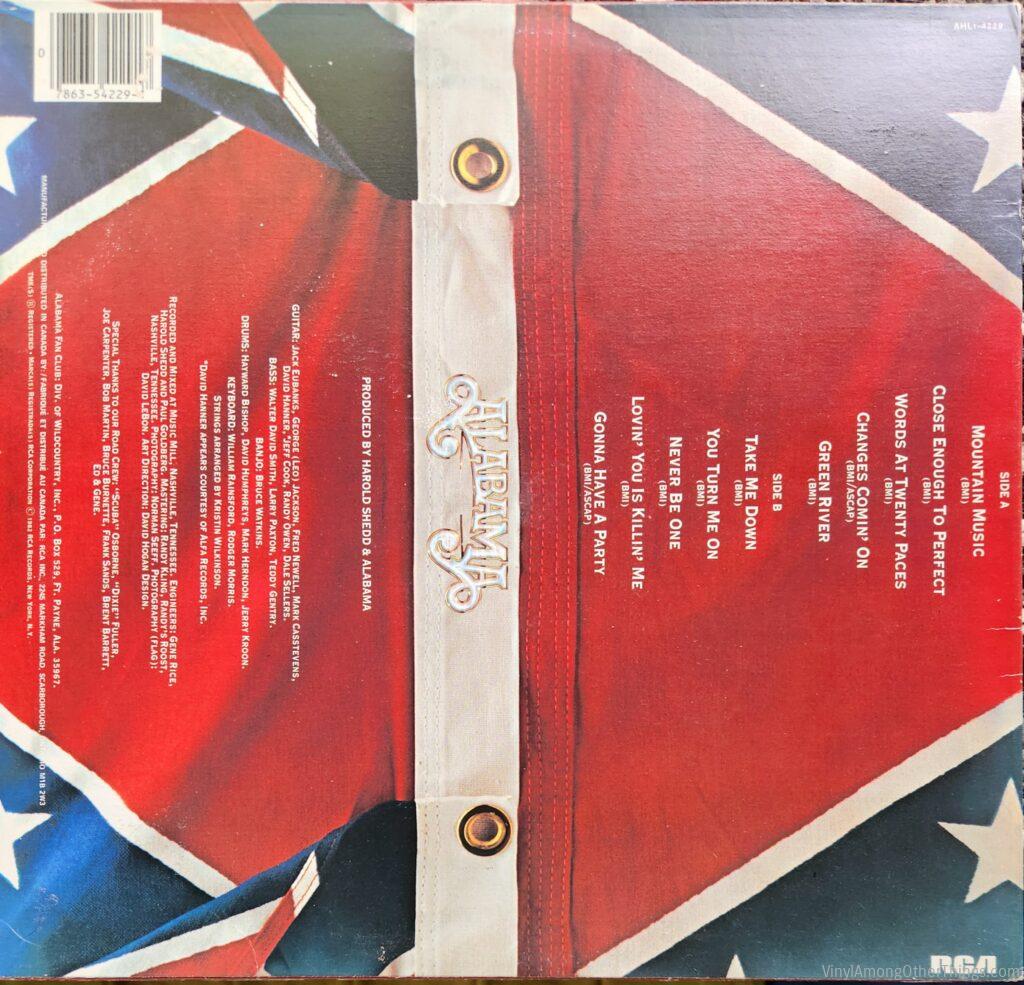
So, let’s address the elephant in the room here, the sleeve. This has got to be just one of the most poorly designed sleeves, and I don’t mean the Confederate flag alone. Look at the pictures above, one is upright, the other is side ways. Did I accidentally forget to rotate the picture? No. Actually, it’s actually sideways, so if you want to read things on it, you turn it to the left so the sleeve opening is towards the ground. We’ll get to who designed it down the line.
Let’s begin. Side One opens with the title track, “Mountain Music” we get some harmonica followed by an older gentleman talking about how he’s going to climb “that mountain over there” and we get some guitar, and vocals. For those that don’t know who Alabama is, they’re a country group that had a lot of great crossover success with this album, they had a 21 Number One single streak in the 80’s as well. This song, definitely a solid album opener. The guitar playing and the little jam session at the end of this song are what really stand out to me. “Close Enough to Perfect” comes next, which also ended up being a number one song single and it’s a slower country track, the story behind this song goes that songwriter, Carl Chambers, came up with the song title while installing strips of wood on the Bellamy Brothers tour bus, when his wife Nancy would come up and find something wrong with it, this happened several times until he was exhausted and frustrated, exclaiming “it’s close enough to perfect for me!” and stopped what he was doing to go write down that title, and later wrote the song about how his wife was being treated back home. “Words at Twenty Paces” follows next, and it’s a more faster paced song, and bit more upbeat. The chorus is pretty good as well. “Changes Comin’ On” follows next, it’s a quieter song, but also one of the longest songs on the album, ringing in at 6:47. The song does mention Martin Luther King, Jr. which is a bit unexpected for an album with a confederate flag. The song does also pick up the pace and volume some. All in all, not an awful song. The A-Side closes out with a cover of Creedence Clearwater Revival’s “Green River” and you know what, covering a CCR song is usually a make or break in most circumstances, because they’re so uniquely John Fogerty, and unfortunately, this one doesn’t hit anywhere near as good as the original. (Most covers don’t.) By the way, if you didn’t know, Alabama comes from Alabama.
“Take Me Down” opens the B-Side, and it starts off slow and downtempo, we do get to the chorus, which is a really well performed section of the song. This song was originally recorded by Exile, but failed to be a hit for them, and you know, you can definitely hear the Exile vibes in the musicianship. This became Alabama’s 7th number one hit. “You Turn Me On” (whoa.) comes next, and it comes off as a bit ballad-y, the spoken word part doesn’t quite hit like it should, at least for me. “Never Be One” comes next, and we continue with another slower song, but this song is definitely about the singers daughter growing up, so I am sure there is some sentimental emotion to it. It ends with the vocalist saying goodnight to his daughter and her saying it back. “Lovin’ You is Killin’ Me” comes next, and it’s a faster paced song, and it’s not too bad. “Gonna Have a Party” ends the album, and it’s a bit repetitive, not overly exciting. All in all, the album was mostly enjoyable, good music, but not overly interesting.
Catalog Number:
AHL1-4229
Credits:
Produced by Harold Shedd & Alabama
Guitars – Jack Eubanks, George (Leo) Jackson, Fred Newell, Mark Casstevens, David Hanner, Jeff Cook, Randy Owen & Dale Sellers
Bass – Walter David Smith, Larry Paxton & Teddy Gentry
Banjo – Bruce Watkins
Drums – Hayward Bishop, David Humphreys, Mark Herndon & Jerry Kroon
Keyboards – William Rainsford & Rodger Morris
Strings Arranged by Kristin Wilkinson
Recorded and Mixed at Music Mill, Nashville, Tennessee
Engineers – Gene Rice, Harold Shedd & Paul Goldberg
Mastering – Randy Kling / Randy’s Roost, Nashville, Tennessee
Photography – Norman Seeff
Photography (Flag) – David LeBon
Art Direction – David Hogan Design
Released:
1982
Find it on Discogs


Hi Colin,
Candi Carley(-Roth)s ‘Joy’ album opens with a ‘Country Western Medley’ that includes ‘Mountain Music’. The copywrite holder granted permission for use in the medley free of charge, unlike the major record company’s. I can’t remember if it was they or the copywrite holder that wanted to hear the medley before approving, but either way permission came fast, a real class act.
Hi Mark,
Glad to see you’re still following along on my blog. It’s been a process to get it back up and running smoothly.
I had to check if I had Candi’s “Joy” album – I don’t unfortunately, but I do have “Candi” “Just for You” and of course, “Sweet City Woman” – I’ll have to write about another one of her albums soon.
That is great that the copyright holder was nice enough to grant permission for it be used.
Colin
Well, to be honest, I just recently started reading them, and I don’t real all of them. Your likes seem to run similar with mine and with a musician in the house, I don’t get a chance to listen as much I used to. But I am keeping my LP collection!
FYI ‘Just For You’ was rereleased as a CD about 5 weeks ago. The vinyl edition sold out in Australia (i.e. the world) in 1988 as did ‘Candi’ and the cassette ‘Candi Carley in Concert’. The cassette is the Holy Grail of Candi Recordings, unlike the LP’s, it was of low quality and few were playable after 5 years.
That’s okay, a lot of my older posts I find need to be redone as I feel I didn’t do the albums justice. I plan to eventually go through some of my older ones.
I do love a lot of music, and I love exploring different genres of music and immersing myself in the different sounds of many decades of music. I’m currently in the process of thinning out my 3,500+ item collection.
That’s great news that ‘Just for You’ was re-released. I’d love to get a copy of a few of Candi’s cassettes.
Would love to send you a JOY cassette, but where to? This is, depending on what you like, Candi’s best. Candi herself is not partial to ‘Candi’ and ‘Just For You’. During the making of the ‘Just For You’ CD I listened to the master at least a dozen times before the manufacturer got it close to right (my expectations exceed what current audio editing equipment is capable of), Candi only listened to some segues about 4 times. She didn’t want to hear anymore. If you do listen to ‘Just for You’, turn up the bass for ‘Serenade,’ Candi gets the Wurlitzer to growl like a lion, but at about 20 Hz, about the bottom of the human range of hearing.
Mark
Hi Mark,
Is the email that you have linked to your comments here good to email you at?
I’ll definitely get my copy of “Just for You” out and do another post about Candi soon!
Except for emergency’s, it’s the only address I use. If you do listen to ‘Just For You’ or ‘Candi,’ keep in mind they are not as good as ‘Sweet City Woman.’ ‘Candi’ has a muffled sound about it, not sure why, but I’ll try to clarify the issue next year for the CD version.
Mark